
NHL Betting: Top Odds & Picks for 2026
 Available in US
Hockey betting occupies a peculiar niche in the sports wagering world. While football dominates American sportsbooks and soccer rules the international scene, hockey offers something different: a fast-paced sport where a single goaltender can determine the fate of your bankroll. The 2025-26 NHL season has seen betting handles grow significantly, with more casual fans discovering that betting on hockey requires a fundamentally different approach than backing touchdowns or three-pointers.
The sport moves at a relentless pace. A team can trail by two goals with five minutes remaining and still win in regulation. A backup goaltender thrust into action due to injury can either collapse spectacularly or channel his inner playoff hero. These variables create opportunities for bettors who understand the game, and expensive lessons for those who treat hockey like any other sport on the board.
What makes hockey betting particularly interesting is the compressed nature of odds. Unlike football, where double-digit point spreads are common, hockey uses a standard 1.5-goal spread called the puck line. This relative parity means value exists throughout the betting card if you know where to look. The difference between a sharp hockey bettor and a recreational one often comes down to understanding these nuances rather than having superior knowledge of roster construction.
This guide covers everything you need to know to bet on hockey intelligently. We start with the fundamentals of how odds work and what types of bets are available. From there, we move into strategies for live betting, playoff wagering, and international leagues beyond the NHL. The goal is not to guarantee winning bets. Anyone promising that is either lying or about to lose a lot of money. Instead, we aim to give you the tools to evaluate hockey betting opportunities critically and manage your bankroll responsibly.
Table of Contents
- Understanding Hockey Betting Basics
- Types of Hockey Bets
- Live Hockey Betting
- NHL Betting Strategies
- Betting on NHL Playoffs
- International Hockey Betting
- Conclusion
- FAQ
Understanding Hockey Betting Basics

How Hockey Odds Work
American odds format dominates NHL betting in North American sportsbooks, expressed as positive or negative numbers relative to a baseline of 100. A negative number indicates the favorite and tells you how much you must wager to win 100 dollars. A positive number indicates the underdog and shows how much you win on a 100-dollar stake. These numbers are not arbitrary; they represent the implied probability the sportsbook assigns to each outcome, with their profit margin baked in.
Consider a typical NHL matchup where one team is listed at -150 and their opponent at +130. The -150 price means you need to risk 150 dollars to profit 100 if that team wins. The +130 price means a 100-dollar bet returns 130 in profit if the underdog pulls off the upset. Converting these to implied probabilities, the favorite has roughly a 60 percent chance of winning according to the market, while the underdog sits at approximately 43 percent. Notice those numbers add up to more than 100 percent. That difference represents the vigorish, the sportsbook's built-in edge that ensures they profit regardless of the outcome.
Understanding this math matters because profitable betting requires finding spots where your estimated probability exceeds the implied probability of the odds offered. If you believe a team has a 55 percent chance of winning but the odds imply only 50 percent, that represents potential value even if the team loses some of the time. This concept applies across all bet types, from simple moneylines to complex prop combinations. The sportsbook sets prices based on their models and the betting action they receive. Your job is to identify where those prices do not accurately reflect reality.
Where to Bet on Hockey
Legal sports betting has expanded dramatically since 2018, with most American states now offering some form of regulated wagering. Licensed sportsbooks operate both online and in physical locations, each with distinct advantages. Online platforms provide convenience and typically offer more betting markets, especially for props and live wagering. Physical sportsbooks at casinos offer a social atmosphere and immediate cash transactions, though their market selection tends to be more limited.
The key features worth evaluating when choosing where to place your hockey bets include the breadth of available markets, the competitiveness of odds, and the quality of the live betting interface. Some books consistently offer sharper lines on NHL games because they take larger limits and have dedicated hockey traders. Serious bettors often maintain accounts at multiple sportsbooks to ensure they always get the best available price on any given wager. This practice, known as line shopping, represents one of the few reliable edges available to recreational bettors.
Mobile betting has become the dominant method for placing wagers, with apps from major sportsbooks offering full functionality on smartphones. The convenience is obvious: you can bet from your couch while watching the game or place a wager in the minutes before puck drop when you get late lineup information. This accessibility carries risks, of course. The same ease that lets you capitalize on late-breaking news also makes it easy to chase losses or bet impulsively.
Types of Hockey Bets

Moneyline Betting
The moneyline represents the purest form of hockey wagering: pick which team wins the game. No point spreads, no goal totals, just victory or defeat. In hockey, moneyline betting includes overtime and shootouts if the game requires them, so the only outcomes are a win for one team or a win for the other. This simplicity makes moneylines the entry point for most new hockey bettors, though the strategy behind them is less straightforward than it appears.
Betting the favorite on the moneyline means accepting lower potential returns in exchange for backing the team more likely to win. The breakeven point matters here. At -150 odds, your chosen team needs to win more than 60 percent of the time for the bet to be profitable long-term. At -200, that threshold rises to 67 percent. Very few NHL teams actually win at those rates over a full season, which explains why blindly backing favorites is a losing strategy. The variance in hockey means that underdogs win often enough to erode any edge from favorite-heavy betting.
Underdog moneyline betting offers the inverse proposition: higher potential returns with lower probability of success. A +200 underdog only needs to win 33 percent of the time to break even, a threshold that many teams exceed in specific situations. The art of underdog betting involves identifying when the market has overcorrected against a team due to recent results, injury concerns, or schedule factors.
Puck Line Betting
The puck line is hockey's version of the point spread, standardized at 1.5 goals for nearly every game. Favorites are listed at -1.5, meaning they must win by two or more goals for the bet to cash. Underdogs get +1.5, which means they can lose by one goal and the bet still wins. This seemingly simple construction creates fascinating strategic wrinkles that experienced bettors exploit throughout the season.
Betting favorites at -1.5 offers enhanced payouts compared to the moneyline because you are taking on additional risk. A team favored at -150 on the moneyline might be +150 on the puck line, reflecting how much harder it is to win by two goals than to simply win. The key factor here is empty-net goals. When a trailing team pulls their goaltender in the final minutes, the leading team has a significantly higher chance of scoring an additional goal into the empty cage. This dynamic means puck line favorites often cover in the final minutes of games they would have won anyway.
Taking underdogs at +1.5 functions as insurance: you win if your team wins outright and you also win if they lose by exactly one goal. The tradeoff is reduced odds compared to the moneyline. A +200 moneyline underdog might be -150 on the puck line, reflecting the increased probability of that outcome. Overtime is particularly relevant for +1.5 bets because any game decided in overtime or a shootout ends with a one-goal margin, meaning the underdog covers automatically. This makes +1.5 underdogs attractive when you expect a close game that could require extra time.
Over/Under Betting
Totals betting asks you to predict whether the combined score of both teams will exceed or fall short of a set number. NHL game totals typically range from 5.5 to 6.5 goals in the current era, reflecting the league's gradual increase in scoring over recent seasons. Unlike moneyline or puck line bets, totals require you to assess both teams' offensive and defensive capabilities together rather than picking a winner.
The over tends to attract more recreational betting action because fans enjoy rooting for goals. Sportsbooks know this and often shade their lines accordingly, making overs slightly worse value than they should be in a perfectly efficient market. This does not mean overs are always bad bets; it simply means you should be certain about your analysis before backing the over just because it feels more exciting. Some of the sharpest hockey bettors focus primarily on totals because they believe the market is less efficient there than on sides.
Several factors heavily influence whether a game goes over or under the posted total. Goaltender matchups matter enormously, perhaps more than any other single factor. A game featuring two elite starters will play differently than one with a backup making his first start in three weeks. Team pace also matters; some squads play structured defensive systems while others embrace high-event hockey with lots of shots and chances. Back-to-back games often trend under because fatigued teams play more conservatively and generate fewer quality scoring opportunities.
60-Minute Line and Three-Way Betting
The 60-minute line, sometimes called three-way betting, offers an alternative to standard moneyline wagering by excluding overtime from the equation. You have three possible outcomes: Team A wins in regulation, Team B wins in regulation, or the game is tied after 60 minutes and goes to overtime. This third option dramatically changes the math and creates opportunities for bettors who think a game will be close.
Betting the regulation draw typically offers odds between +300 and +400 depending on how evenly matched the teams appear. Historically, approximately 23 percent of NHL games reach overtime, making the draw a viable option that many casual bettors ignore entirely. If you believe two teams are closely matched and neither has a decisive advantage, the draw offers positive expected value at certain price points. The challenge is that most bettors are psychologically uncomfortable backing a tie; it feels unsatisfying compared to picking a winner.
The regulation moneyline prices adjust to account for the draw's presence. A team that might be -140 on the standard moneyline could be +110 on the 60-minute line because you are only getting paid if they win in regulation. This creates strategic options: if you strongly believe a team will win but suspect the game could be close, you might split your action between the 60-minute line and the draw rather than laying juice on the standard moneyline. These combinations are not for beginners, but they illustrate how additional betting options can be deployed creatively.
Futures Betting
Futures markets let you bet on outcomes determined over weeks or months rather than a single game. The most popular hockey futures include Stanley Cup winner, conference champions, division winners, and individual awards like the Hart Trophy for league MVP or the Vezina Trophy for best goaltender. These bets are placed well in advance and require patience; your money is tied up until the outcome is decided.
Stanley Cup futures offer substantial payouts because predicting a champion before the season or even mid-season involves significant uncertainty. Pre-season odds for eventual winners typically range from +500 to +2000, depending on how heavily favored the team is. The advantage of futures betting is locking in value before the market adjusts. If you identify a team poised for a breakout season before the betting public catches on, you can secure odds that will never be available again once their success becomes apparent.
The timing of futures bets creates strategic considerations that do not exist in game-by-game wagering. Pre-season futures carry the most uncertainty but also offer the best prices. Mid-season futures let you incorporate new information but at reduced odds. Playoff futures once the bracket is set provide the clearest picture but the least value. Some bettors prefer taking shots on longshots before the season and hedging if those teams make deep playoff runs. Others wait until January or February when roster construction and team performance provide more reliable indicators.
Prop Bets
Proposition bets, commonly called props, focus on specific events within a game rather than the final outcome. Player props include categories like goals scored, assists, points, shots on goal, and saves for goaltenders. Game props cover things like which team scores first, whether both teams will score in the first period, or the exact final score. These markets have exploded in popularity and now represent a significant portion of total NHL betting handle.
Player props offer opportunities to leverage specific knowledge about individual matchups or usage patterns. If a top scorer is facing a team that allows the most shots in the league, his shots on goal prop might be worth targeting. If a defenseman has been on the ice for the last ten power-play goals his team has scored, his point props could offer value. The challenge is that sportsbooks have become increasingly sophisticated at pricing props, and lines adjust quickly when sharp bettors identify soft numbers.
Same-game parlays have become the vehicle through which most recreational bettors engage with props. These products let you combine multiple prop bets from a single game into one wager with enhanced odds. The correlation between outcomes is supposed to be priced into the parlay odds, but sportsbooks often price same-game parlays generously to encourage action. For example, betting that a team wins, the game goes over the total, and a specific player scores is a positively correlated set of outcomes that books might not penalize fully. The downside is that hitting multiple legs is genuinely difficult, and the house edge on parlays exceeds that of straight bets.
Parlay and Grand Salami
Standard parlays combine multiple game outcomes into a single wager where all legs must hit for the bet to pay. The appeal is obvious: parlay odds multiply together, so a four-team parlay might pay 10-to-1 or better. The mathematical reality is less appealing: the house edge compounds with each added leg, making parlays a consistently losing proposition over large sample sizes. That said, parlays are entertaining and allow bettors to turn small stakes into meaningful payouts when they hit.
The Grand Salami represents a unique hockey-specific total: the combined goals scored across all NHL games on a given day. If eight games are scheduled, the Grand Salami might be set at 47.5 total goals, and you bet whether the actual combined total will go over or under that number. This bet effectively diversifies your action across the entire slate rather than concentrating on individual games.
Grand Salami betting attracts bettors who believe they can identify broader trends affecting league-wide scoring. If the schedule features several tired teams on back-to-backs, the under might have value. If multiple backup goaltenders are scheduled to start, the over could be worth considering. The challenge is that sportsbooks incorporate publicly available information about fatigue and goaltending into their lines.
Live Hockey Betting
In-Play Betting Mechanics
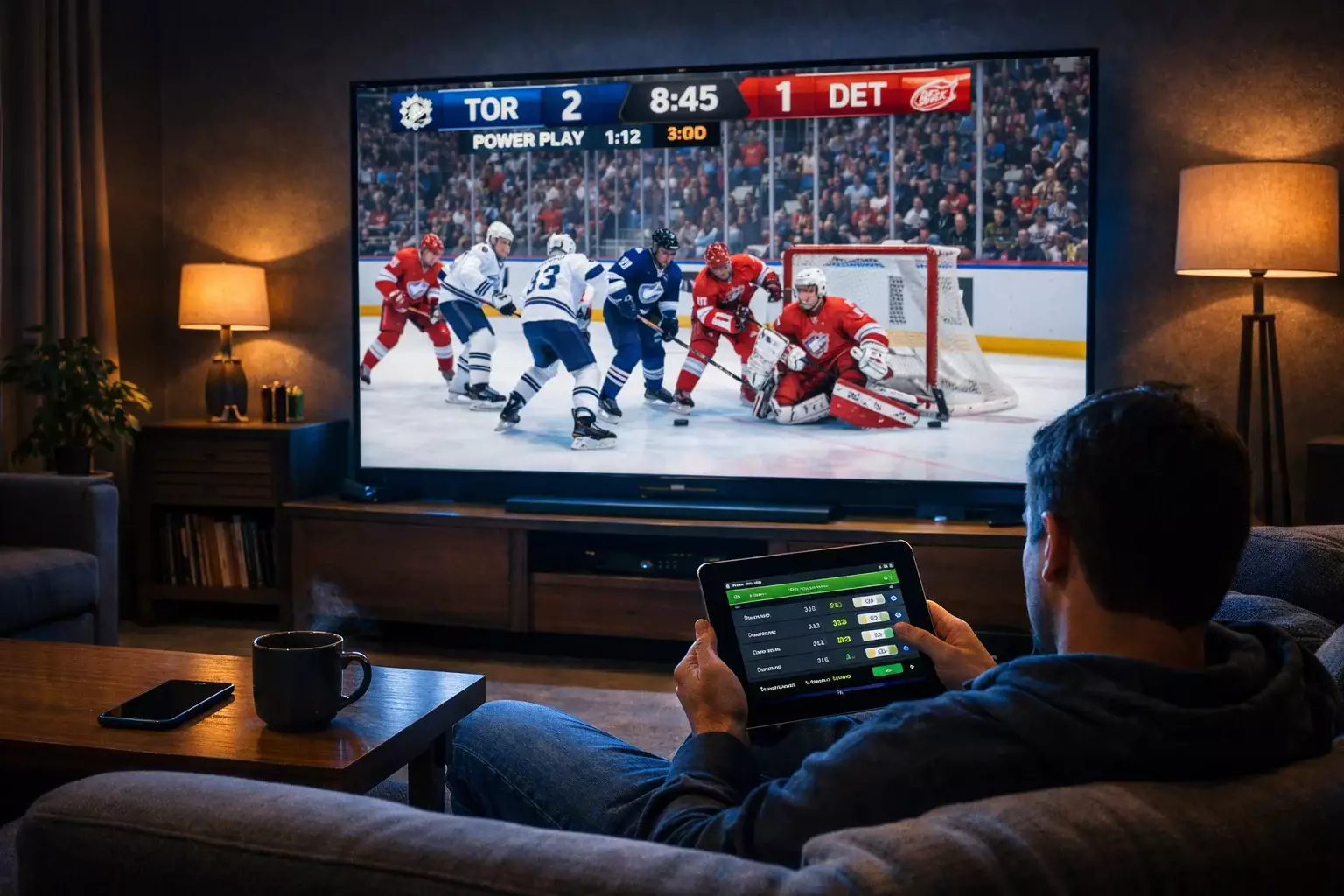
Live betting allows you to place wagers while the game is in progress, with odds updating continuously based on the score, time remaining, and game flow. This dynamic environment rewards bettors who can process information quickly and identify when the live odds do not reflect the true state of the game. The markets available during live betting include moneylines, puck lines, totals, and various props like next goal scorer or period outcomes.
Odds during live betting move aggressively in response to goals because scoring changes the expected outcome substantially. A team that was -150 pre-game might become +200 if they allow an early goal, even if the underlying quality of the two teams has not changed. This creates opportunities for bettors who had a pre-game opinion that becomes available at better odds after a score. The challenge is that sportsbooks employ sophisticated models that incorporate expected goals, shot attempts, and other advanced metrics to set live prices. Beating the market requires either faster information or better analysis than their algorithms provide.
The timing of live bets matters enormously. Most sportsbooks suspend betting during active play and only accept wagers during stoppages. This creates a rhythm where you must decide quickly during whistles and then watch helplessly as the action unfolds. Some platforms offer continuous betting with slightly worse odds, allowing you to bet mid-play but at a cost. Understanding your sportsbook's specific procedures for live betting prevents frustration and ensures you can execute your strategy when opportunities arise.
Live Betting Strategies
Successful live betting requires preparation that begins before puck drop. Identify specific scenarios where you would want to bet live and at what prices. If you believe a team is undervalued pre-game but do not want to lay -150, you might wait for them to fall behind by a goal and take them at plus money. This approach requires discipline; the team might never fall behind, and you miss the opportunity entirely. But when your predicted scenario unfolds, you execute a bet you have already analyzed rather than making impulsive decisions.
Momentum shifts in hockey create compelling live betting situations. A team that has dominated shot attempts and scoring chances but trails due to unlucky bounces or outstanding goaltending is a potential live target. The eye test matters here: actually watching the game reveals information that the score alone does not capture. However, be cautious about overweighting recent events. A team that scores twice in two minutes has not necessarily seized permanent control of the game; hockey is volatile, and runs in both directions happen constantly.
Power play situations offer specific live betting angles. When a key player takes a penalty, the live odds shift to reflect the increased scoring probability during the ensuing power play. If you believe a particular team's power play is overrated or underrated, these situations let you express that opinion with immediate feedback. Similarly, goaltender changes during games create dramatic line movements that sometimes overcorrect. A backup entering after an injury might be perfectly capable, but the market might price the transition as catastrophically negative.
NHL Betting Strategies

Fundamental Analysis
Effective hockey handicapping begins with understanding the matchup in front of you. Team quality is not static across all situations; a squad might dominate at home but struggle on the road, excel at even strength but collapse on special teams, or play up to elite competition while losing to bottom feeders. Breaking down these tendencies reveals where the betting market might be making assumptions that do not hold for the specific game you are analyzing.
Schedule factors deserve more attention than most casual bettors give them. The NHL regular season is a grind featuring 82 games crammed into roughly seven months. Teams playing the second night of a back-to-back are at a documented disadvantage, particularly when traveling. Road trips of four or more games wear teams down progressively. Meanwhile, extended home stands allow teams to rest and practice. These factors are priced into the market to some degree, but not always fully, especially in situational spots that the betting public overlooks.
Home ice advantage in hockey is real but modest, worth roughly 2-3 percent to the home team in win probability according to most analyses. This advantage has declined over the decades as travel has become easier and arena conditions have become more standardized. Still, certain buildings maintain reputations for being particularly difficult places to play due to crowd noise, altitude, or travel logistics. Denver sits at elevation that affects visiting teams who arrive the day of the game. Canadian arenas feature passionate crowds that create genuinely hostile environments. These edges are small but can tip marginal decisions when combined with other factors.
Goaltender Analysis
No position in major professional sports influences individual game outcomes more than the goaltender in hockey. A hot goaltender can steal games his team has no business winning, while a struggling one can sabotage an otherwise dominant performance. Identifying who starts in goal and assessing their current form represents the single most important piece of pre-game analysis for hockey bettors.
The challenge is that starting goaltenders are often not confirmed until the morning of the game, and sometimes not until warmups. Teams have strategic incentives to obscure this information, particularly before playoff games or important matchups. Bettors who access reliable goaltender information first gain an edge, as lines will move once the market learns who is starting. Following beat reporters for each team and monitoring official team announcements provides the fastest access to this crucial information.
Traditional goaltender statistics like save percentage and goals against average tell part of the story but not all of it. Goals Saved Above Expected measures a goaltender's performance relative to the quality of shots he faces, controlling for the difficulty of his workload. A goaltender with a pedestrian save percentage might actually be performing well if he faces an unusual number of high-danger chances due to poor defensive play in front of him. Conversely, a seemingly elite save percentage can mask a light workload against mostly low-danger shots.
Advanced Analytics
The hockey analytics community has developed numerous metrics that capture team and player quality beyond traditional statistics. Corsi and Fenwick measure shot attempts for and against at even strength, providing insight into which team controls play. Expected Goals models assign probability values to each shot based on location, type, and game state, offering a more nuanced view of scoring chance quality than raw shot counts.
Applying these metrics to betting requires understanding what they capture and what they miss. A team that dominates Corsi but underperforms in actual goals likely has some combination of bad luck and poor goaltending or finishing. If the underlying metrics are strong, regression toward expected results should follow. This framework helps identify teams that are better or worse than their records suggest.
The limitation of analytics-driven betting is that the market incorporates this information too. Sportsbooks employ quantitative analysts who build sophisticated models using the same publicly available data that retail bettors access. Finding edges requires either better models, faster information, or insights that the market has not fully priced.
Line Shopping and Value
The difference between grabbing -150 at one sportsbook versus -140 at another seems small on any individual bet but compounds significantly over time. A bettor who consistently gets better lines will outperform an identical bettor making the same picks at worse prices by several percentage points over a season. This is pure math, not skill, and represents the lowest-hanging fruit available to sports bettors of any experience level.
Line shopping requires maintaining funded accounts at multiple sportsbooks and checking prices before placing any significant wager. Various comparison tools aggregate odds across legal books, making this process quick once you establish the habit. The effort involved is minimal compared to the edge gained. Even finding one point of value on a small minority of bets generates meaningful returns over large sample sizes.
Line movement itself conveys information about how the market views a particular game. Sharp money from professional bettors tends to move lines early in the week when limits are lower and sportsbooks are establishing prices. Public money from recreational bettors typically comes later, especially on weekends and closer to game time. Tracking which direction lines move and when can help identify which side the sharper money favors, though this information has become harder to exploit as sportsbooks have improved their speed of adjustment.
Bankroll Management
Every betting strategy is ultimately filtered through bankroll management. The best analytical edge in the world cannot overcome reckless bet sizing that exposes you to ruin. Professional bettors typically risk between 1 and 5 percent of their bankroll on individual wagers, with the specific percentage depending on their confidence and edge size. Recreational bettors should lean toward the conservative end of this range.
Unit-based betting provides a framework for consistent sizing. Define a unit as a fixed percentage of your bankroll, perhaps 1 or 2 percent. Bet one unit on standard plays and up to three units on your highest-confidence selections. This approach prevents chasing losses with oversized bets and ensures that no single bad beat destroys your bankroll. The discipline required to stick to unit sizing during losing streaks is what separates bettors who survive long-term from those who bust out.
Variance in hockey betting is particularly brutal because the sport itself is volatile. A team can dominate every meaningful metric and still lose due to a bad bounce or a hot opposing goaltender. Accepting this variance emotionally while managing it mathematically is essential. Your results over 50 or 100 bets will not necessarily reflect your skill; you need hundreds or thousands of bets for true edge to emerge from noise. Bet sizing that allows you to survive the inevitable downswings keeps you in action long enough for your edge to materialize.
Betting on NHL Playoffs

Playoff Betting Differences
The NHL playoffs operate under different dynamics than the regular season, and your betting approach should adjust accordingly. Teams play tighter defensive hockey when elimination looms. Physical play intensifies. Goaltenders face increased scrutiny, and their performance variance seems to expand in both directions.
Scoring tends to decrease in the playoffs. Teams take fewer risks, block more shots, and prioritize structure over individual creativity. This has implications for totals betting, as numbers that regularly hit over during the regular season might play under in a seven-game series against a committed defensive opponent. The public often does not adjust quickly enough for this shift, creating potential value on playoff unders, particularly in later rounds when the remaining teams are the best defensive units.
Series betting offers markets that do not exist during the regular season. You can bet which team wins a best-of-seven series outright, the exact number of games in the series, and whether the series reaches a specific number of games. These bets require thinking about multiple possible paths rather than a single game.
Stanley Cup Futures
Betting on the Stanley Cup winner represents the ultimate delayed gratification in hockey wagering. You might place a bet in October that does not resolve until June, with countless twists between. The advantage is locking in value on teams before their success becomes obvious. The disadvantage is opportunity cost; that money cannot be deployed elsewhere while waiting for resolution.
The optimal timing for Stanley Cup futures depends on your information advantage and risk tolerance. Pre-season bets offer the best odds but the most uncertainty about roster construction, health, and team chemistry. January or February bets incorporate half a season of data while still offering reasonable prices on contenders. Betting once the playoffs begin provides maximum information but minimal value; a team priced at +200 to start the playoffs was probably available at +800 before the season.
Hedging futures becomes relevant when your selected team advances deep into the playoffs. If you took a longshot at +2000 and they reach the conference finals, you can guarantee profit by betting their opponent in subsequent rounds. The tradeoff is reducing your maximum upside in exchange for certainty. Some bettors prefer letting futures ride for the full potential payout; others hedge progressively as their equity grows. Neither approach is objectively correct; it depends on your utility function and how much the certain money matters relative to the possibility of more.
International Hockey Betting
Other Leagues to Bet On
The NHL is not the only hockey league with robust betting markets. European leagues, particularly the KHL in Russia and the SHL in Sweden, offer daily action during the winter months. The Finnish Liiga, Czech Extraliga, and Swiss National League also attract betting interest. These leagues differ from the NHL in style of play, roster quality, and available information, creating both opportunities and pitfalls for bettors accustomed to North American hockey.
The KHL features the highest quality of play outside the NHL, with former NHL players and top European talent filling rosters. The league plays a schedule similar to the NHL, and betting markets include moneylines, puck lines, and totals. However, information flow is less reliable than in North America. Injury reports may be incomplete, and lineup decisions sometimes remain opaque until game time. Bettors who develop information edges in these leagues can find value that is unavailable in the more efficiently priced NHL market.
College hockey in the United States and the AHL, the NHL's primary developmental league, also offer betting opportunities. These markets are thinner, meaning odds can vary more significantly between sportsbooks and lines may not fully reflect true probabilities. The challenge is that roster turnover in college is constant, and AHL lineups fluctuate as players move up and down from the NHL. Specializing in a specific league and developing expertise that casual observers lack is the path to potential profitability in these smaller markets.
International Tournaments
The IIHF World Championship, held annually in May, features national teams competing during a period when NHL playoffs are ongoing. The tournament includes teams eliminated from Stanley Cup contention as well as European players whose seasons have concluded. This creates unpredictable rosters where a nation's strength depends on which NHL players are available. Betting on the World Championship requires tracking roster announcements carefully and adjusting expectations based on who actually suits up.
Olympic hockey, when professionals are permitted to participate, represents the highest-stakes international competition. The 2026 Winter Olympics in Milan-Cortina will feature NHL players for the first time since 2014, creating significant betting interest. The compressed tournament format and best-on-best competition produce different dynamics than league play. Goaltending often becomes the decisive factor in short tournaments, as a hot goaltender can carry a less talented team to medal contention.
Conclusion
Betting on hockey successfully requires respecting what makes the sport unique. The role of goaltending, the compressed nature of odds, the standard 1.5-goal puck line, and the high variance from game to game all demand approaches tailored to these realities. Bettors who apply frameworks from other sports without adaptation will struggle. Those who invest time in understanding hockey-specific dynamics position themselves to identify value others miss.
The practical steps are straightforward even if execution is difficult. Learn to read odds and convert them to implied probabilities. Understand the different bet types available and when each offers value. Develop a process for evaluating goaltender matchups and team quality in specific situations. Shop lines religiously to ensure you get the best available prices. Manage your bankroll conservatively enough to survive the inevitable variance.
Nothing in this guide guarantees profitable betting. The sportsbooks employ smart people with sophisticated models who set lines designed to extract your money. What this guide provides is the foundation for engaging with hockey betting intelligently, understanding what you are actually betting on, and avoiding the most common mistakes that doom recreational bettors.
The 2025-26 NHL season offers over 1,300 regular season games plus playoff rounds extending into June. Start small, focus on developing your process, and remember that even the sharpest bettors lose a significant percentage of their wagers. Survival and improvement over time matter more than any individual bet.
Bet responsibly. Set limits on your bankroll and stick to them. If betting stops being fun or begins causing problems in your life, seek help. Organizations like the National Council on Problem Gambling provide resources for those who need them.
FAQ
What is a puck line bet and how does it work?
The puck line is hockey's equivalent of a point spread, standardized at 1.5 goals for virtually every NHL game. When you bet the favorite on the puck line at -1.5, that team must win by two or more goals for your bet to cash. Betting the underdog at +1.5 means they can lose by one goal and you still win, or of course win outright. The 1.5-goal line exists because hockey is a low-scoring sport where most games are decided by one or two goals, and a half-goal prevents pushes.
The odds attached to puck line bets differ significantly from moneyline odds because you are betting on a different outcome. A team favored at -150 on the moneyline might be +140 on the puck line because covering 1.5 goals is considerably harder than simply winning. Conversely, that same team's opponent might be +130 on the moneyline but -160 on the puck line because getting 1.5 goals is a substantial cushion. Empty-net goals in the final minutes frequently determine puck line outcomes, as leading teams often extend their margin when the trailing team pulls their goaltender.
Overtime affects puck line bets in an important way. Since overtime and shootouts can only produce a one-goal winning margin, any game that reaches overtime results in the underdog covering +1.5 automatically. This makes +1.5 underdogs attractive in games you expect to be closely contested. The favorite needs to win in regulation by two or more goals to cover -1.5; winning in overtime is not sufficient.
Does overtime count in hockey betting?
Overtime rules depend entirely on which bet type you have placed. Standard moneyline bets include overtime and shootouts. If you bet a team to win on the moneyline and they win in overtime or a shootout, your bet cashes. There are only two possible outcomes for moneyline bets: your team wins or your team loses. Regulation ties that proceed to overtime are not pushes on standard moneylines.
Totals and puck lines also include overtime, though the implications differ. For totals, any goals scored in overtime count toward the over/under, but shootouts only contribute one goal total to the winning team regardless of how many rounds are required. For puck lines, overtime produces a one-goal margin as noted above, meaning underdogs at +1.5 automatically cover while favorites at -1.5 automatically fail to cover whenever a game requires extra time.
The 60-minute line or three-way betting explicitly excludes overtime. These bets offer three outcomes: Team A wins in regulation, Team B wins in regulation, or the game goes to overtime as a draw. If you bet either team on the 60-minute line and the game reaches overtime, both team bets lose and the draw bet wins. This is the only common hockey betting market where overtime does not count toward your selected team's result.
What are the best strategies for betting on NHL games?
Goaltender research should be your starting point for any NHL bet. Confirm who is starting for both teams, evaluate their recent form and season-long metrics, and consider how the workload and matchup affect expectations. A confirmed elite starter versus a struggling backup shifts the probability distribution meaningfully. No other single piece of information matters as much in hockey betting.
Line shopping across multiple sportsbooks takes minimal effort but generates guaranteed value over time. The difference between -145 and -140 seems trivial but compounds across hundreds of bets. Maintain accounts at several legal sportsbooks and check prices before placing any significant wager. This is not a strategy that requires skill; it is simple discipline that improves returns regardless of your analytical abilities.
Specialization beats broad coverage for most recreational bettors. Rather than betting every NHL game, focus on specific teams, divisions, or bet types where you can develop expertise. Learn the tendencies of particular clubs, their performance in specific situations, and how the market tends to price them. Deep knowledge of a narrow area produces better results than shallow knowledge of the entire league. The betting market is efficient enough that casual observation rarely reveals exploitable edges.
