The standard NHL moneyline includes overtime and the shootout. You pick a team, and if they win by any means — regulation, OT, or the skills competition — your bet cashes. The 60-minute line strips away all of that. It asks a cleaner question: what happens in regulation time only? And because it allows for a third outcome — a draw after sixty minutes — it changes the math, the pricing, and the strategy in ways that most bettors never bother to explore.
The three-way moneyline is the less popular sibling of the standard moneyline, and that is precisely why it is interesting. Less popularity means less market efficiency. Less market efficiency means more opportunity for bettors who understand how the three-way line works and when it offers better value than the standard two-way moneyline. If you have been betting exclusively on the standard moneyline and ignoring the 60-minute alternative, you have been leaving a useful tool on the shelf.
Mechanics of Regulation-Time NHL Bets
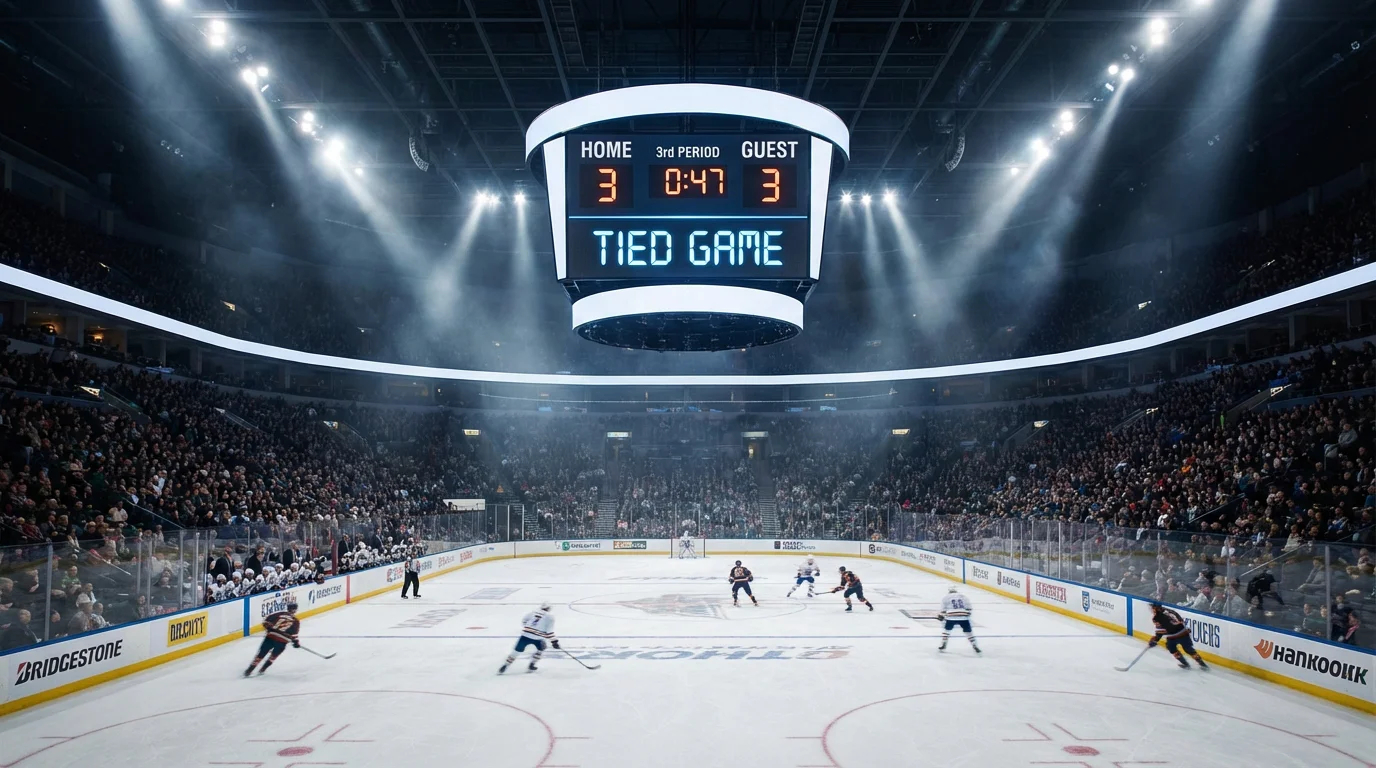
A regulation-time bet — also called the 60-minute line — settles based on the score at the end of the third period, before any overtime or shootout. If the game is tied after sixty minutes, the bet resolves as a draw. There is no push and no carried-over result. The draw is a distinct outcome with its own price.
This creates a three-way market: Team A wins in regulation, Team B wins in regulation, or the game is tied after regulation. Each outcome carries its own odds, and the three implied probabilities sum to more than 100% (the overage being the vig). A typical three-way line might look like: Home team -1.5 (implied roughly 48%), Away team +200 (implied roughly 33%), Draw +280 (implied roughly 26%). The actual percentages depend on the matchup, but the structure is consistent across every game.
The critical distinction from the standard moneyline is the removal of overtime. In the standard two-way moneyline, the favorite benefits from overtime because they still have a chance to win even if they fail to get the job done in regulation. On the 60-minute line, the favorite needs to win outright in regulation — no safety net. This means 60-minute line favorites are priced at longer odds than their two-way counterparts, which creates a different risk/reward profile.
For underdogs, the dynamic inverts. The standard moneyline underdog needs to win the game outright — through regulation, overtime, or the shootout. The 60-minute line underdog only needs to win in regulation, and separately, the draw covers the scenario where they hold on through sixty minutes without losing. This means the underdog’s “not losing in regulation” probability is actually higher than their outright win probability, which is captured in the draw option rather than the underdog’s 60-minute price.
The Three-Way Moneyline: Understanding the Draw
The draw is the most overlooked option in the three-way market, and it is also the most structurally interesting. Roughly 21-24% of NHL regular-season games are tied at the end of regulation — they go to overtime or the shootout. That means the draw hits more than one in five games, which makes it a frequent enough outcome to build a strategy around.
The draw is typically priced between +240 and +300, depending on the matchup. At +280, the implied probability is approximately 26%. If the true probability of a regulation draw in a given game is closer to 24% — which league-wide data suggests is reasonable for closely matched teams — the draw carries a persistent positive expected value at standard pricing. This does not mean you should bet the draw in every game, but it does mean the draw is systematically underpriced in certain game types.
Games between closely matched teams are the strongest candidates for draw bets. When two teams of similar quality meet, the probability of a regulation draw increases because neither team is likely to build a multi-goal lead. Divisional matchups, where familiarity breeds tight checking, also produce draws at a higher rate. And games featuring two strong goaltenders — the kind that suppress scoring across all three periods — are more likely to reach the third period tied, which is the prerequisite for a regulation draw.
The draw also has a practical advantage in bankroll terms. At +280, a winning draw bet returns 2.8 times your stake. This means you can afford to lose several draw bets before a single win puts you back in the black. The hit rate is low compared to a moneyline favorite, but the payout compensates. For bettors who are comfortable with a lower win frequency in exchange for higher returns per win, the draw market is a natural fit.
60-Minute Line vs. Standard Moneyline: Which Offers Better Value?
The choice between the 60-minute line and the standard moneyline depends on the specific game and your assessment of how it will play out. Neither is universally better. Each has situations where it offers the superior risk-adjusted return.
The standard moneyline is the better choice when you believe a team will win but you are not confident they will do it in regulation. If you are backing a team with a strong overtime record — perhaps one with elite three-on-three players who thrive in the open-ice format — the standard moneyline gives you credit for OT and shootout wins that the 60-minute line does not. You pay a higher price (shorter odds) for this coverage, but you also capture a wider range of winning scenarios.
The 60-minute line favorite is the better choice when you believe the team will win convincingly in regulation. If the matchup, goaltending, and schedule factors point toward a comfortable home win, the 60-minute line offers a longer price on the same outcome because it removes the overtime cushion. You are being compensated for the risk that the game might go to OT, and if your analysis says OT is unlikely in this specific matchup, you are getting paid for risk you do not believe exists.
The mathematical comparison is instructive. Suppose the standard moneyline on a favorite is -150 (implied 60%) and the 60-minute line on the same team is +105 (implied 48.8%). If you believe the team has a 52% chance of winning in regulation, the 60-minute line has positive expected value (+105 at a 52% hit rate) while the standard moneyline may not (-150 at a 60% implied probability, when the team’s total win probability including OT might be 58%). The numbers will vary game to game, but the principle holds: the 60-minute line can offer value on favorites that the standard moneyline does not, specifically when the regulation win probability is higher than the market’s implied probability.
For underdogs, the standard moneyline includes the possibility of winning in OT or the shootout, which adds value. But if your thesis is that the underdog can compete closely and the game is likely to be tight, the draw option on the three-way market lets you profit from a different angle entirely — the underdog does not need to win at all, just survive regulation without trailing.
When to Use the 60-Minute Line
Several game scenarios lend themselves naturally to the 60-minute line rather than the standard moneyline.
Heavy favorite situations are the first. When a team is priced at -200 or steeper on the standard moneyline, the juice is thick and the potential return is minimal. The same team on the 60-minute line might be priced at -110 or even money, offering a dramatically better return for the same core thesis — that this team is going to win. The trade-off is accepting the risk of a draw, but in a game where the favorite is expected to dominate, the draw probability is lower than the league average, which makes the trade-off favorable.
Games between evenly matched teams are the second scenario. When the standard moneyline is close to a pick’em — say, -115/+105 — the three-way market often offers better value on the draw than on either team’s 60-minute line. In these games, the probability of a regulation draw is at or above the league average, and the draw price (+250 to +280) may understate the true likelihood. Betting the draw in competitive games is a strategy that does not work every night, but it can be profitable over a large sample if you are selective about which games qualify.
Back-to-back and fatigue situations are the third. When a tired team is on the road and the game projects as low-scoring, the probability of a regulation draw increases. Fatigue suppresses scoring, and low-scoring games are more likely to be tied after sixty minutes. If the line has not fully adjusted for the elevated draw probability in these situations, the three-way draw offers value.
The key is to always compare the 60-minute line to the standard moneyline before betting. Calculate the implied probabilities of both, estimate your own regulation-win and draw probabilities, and choose the market that offers the largest positive expected value gap. This comparison takes an extra minute per game but can meaningfully improve your market selection over time.
The Third Option Is Not a Gimmick
The draw on the three-way moneyline is the most consistently undervalued outcome in NHL regular-season betting. The market prices it as a minority outcome — which it is — but the pricing often understates the true frequency by two to four percentage points, which is a meaningful gap at plus-money odds.
This is not because sportsbooks are unaware of draw frequencies. It is because the betting public overwhelmingly prefers to bet on teams rather than on draws. People want to root for a winner. They want to pick a side. The draw is the unsexy middle ground — a tie after sixty minutes feels like a non-result, even though it is a real and frequent outcome that pays handsomely when you are on the right side of it.
The bettors who exploit this market are the ones who have internalized a simple truth: in betting, you do not need to pick winners. You need to find prices that are wrong. The draw on the three-way moneyline is wrong often enough to build a sustainable edge around, especially in games between evenly matched teams with strong goaltending and conservative coaching. It will never be the most exciting bet on the board. It does not need to be.
