

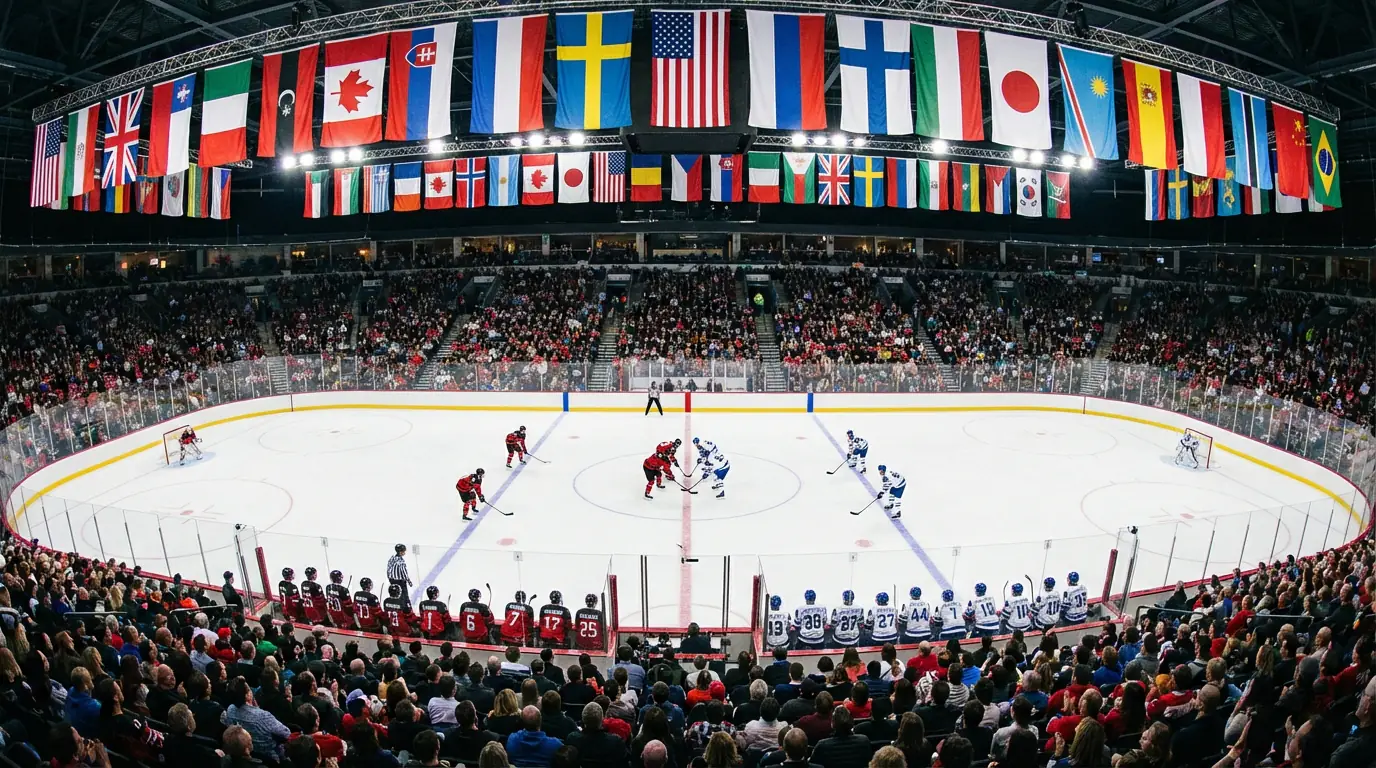
The NHL commands the spotlight in hockey betting, but it is not the only game in town. Across Europe and beyond, professional hockey leagues operate from September through April with their own schedules, their own rules, and their own betting markets. The KHL in Russia, the SHL in Sweden, Finland’s Liiga, the Czech Extraliga, and international tournaments under the IIHF umbrella all offer wagering opportunities — and in many cases, those opportunities carry less market efficiency than the NHL because the betting public pays them far less attention.
Betting on international hockey is not simply a matter of applying NHL analysis to a different league. The rules are different. The ice surfaces are different. The talent level varies. And the information infrastructure — the availability of advanced stats, injury reports, and lineup confirmations — is less developed than what NHL bettors are accustomed to. But for those willing to invest the time to understand these markets, the reduced competition among bettors can produce value that the heavily scrutinized NHL rarely offers.
European Hockey Markets: KHL, SHL & Liiga
The Kontinental Hockey League is the second-strongest professional hockey league in the world by talent level, featuring a mix of former NHL players, top European talent, and developing prospects. The KHL season runs from September to approximately April, with a playoff structure that mirrors the NHL’s best-of-seven format. Betting markets on KHL games are available at most major international sportsbooks, though liquidity is lower than for the NHL, and the lines are set with less precision.
The KHL presents unique challenges for bettors. Information flow is less transparent than in North America — injury reports are inconsistent, lineup confirmations can be unreliable, and coaching decisions are sometimes influenced by factors unrelated to on-ice performance. Teams owned by state-affiliated entities may make roster and lineup decisions based on politics or optics rather than competitive optimization. These information gaps create both risk and opportunity. If you can develop reliable information sources for KHL teams, you are operating in a market where most bettors are flying blind.
The Swedish Hockey League is the strongest league in Scandinavia and consistently produces NHL-caliber talent. The SHL plays on international-sized ice (60 by 30 meters, roughly 197 by 98 feet, compared to the NHL’s 200 by 85 feet), which affects the style of play significantly. Games tend to feature more skating, more puck movement, and fewer physical confrontations than NHL games. Scoring rates differ as well — SHL games can be higher or lower scoring depending on the season and the specific matchup, but the wider ice creates more space and more transition opportunities.
Finland’s Liiga operates at a similar talent level to the SHL, with its own tactical tendencies. Finnish hockey emphasizes structured defensive play and disciplined positioning, which tends to produce lower-scoring games than the SHL. The Czech Extraliga and Germany’s DEL round out the major European leagues, each with their own characteristics and betting markets.
For bettors transitioning from the NHL to European leagues, the most important adjustment is to the ice surface. International-sized ice changes the game fundamentally. Forechecking is less effective because there is more room to escape pressure. Power plays operate differently because the extra space allows for more puck movement. Defensive systems spread out, which can create more odd-man rushes but also more time for goaltenders to read plays. Any model or heuristic you have developed for NHL betting needs to be recalibrated — not discarded, but adjusted — for the wider international game.
Rule Differences That Affect Betting
Beyond the ice surface, several rule differences between international and NHL hockey have direct implications for betting.
Overtime formats vary by league. The KHL uses a five-minute three-on-three overtime followed by a shootout, similar to the NHL. The SHL uses the same format. But some European leagues and international tournaments use different configurations — five-on-five overtime in playoff rounds, or extended overtime periods rather than shootouts. These differences affect the probability of a game ending in regulation versus going to extra time, which directly impacts three-way moneyline and puck line pricing.
Penalty rules differ in enforcement, if not in the rulebook itself. European referees tend to call games more strictly than their NHL counterparts, resulting in more power play opportunities per game. This inflates the expected contribution of special teams to game scoring and should push totals higher in European leagues relative to what you might expect based on even-strength play alone. A team with an elite power play in the SHL benefits from that unit more frequently than an equivalent team in the NHL.
Point systems in European leagues also differ. Many leagues award three points for a regulation win, two points for an overtime or shootout win, and one point for an overtime or shootout loss. This incentive structure changes team behavior in the third period — trailing teams may push harder for a regulation equalizer, knowing the point differential between OT and regulation results is larger. This behavioral shift affects game flow, third-period scoring, and live betting dynamics in ways that the NHL’s two-point system does not replicate.
IIHF World Championship and International Tournaments
The IIHF World Championship, held annually in May, is the marquee international hockey tournament outside the Olympics. It features national teams from across the globe competing in a round-robin group stage followed by a knockout bracket. For bettors, the World Championship offers a concentrated burst of action in a market that is thinner and less efficient than any professional league.
The tournament’s timing is its defining characteristic for betting purposes. It takes place during the NHL playoffs, which means that NHL players whose teams have been eliminated are available while players on active playoff teams are not. This creates a constantly shifting talent pool. A team like Canada or the United States might have a roster loaded with NHL players who were eliminated in the first round, while a team like Finland might rely more heavily on European-league players supplemented by a handful of NHL contributors. The roster composition changes the dynamic dramatically — and the betting market does not always adjust cleanly.
Group stage games in the World Championship are often mismatched. Top-tier hockey nations (Canada, the United States, Finland, Sweden, the Czech Republic) face off against lower-tier programs (Great Britain, Austria, Kazakhstan, Latvia) in early rounds where the talent gap is enormous. These mismatches are easy to identify but hard to bet profitably because the pricing reflects the gap — you might see a -800 or -1000 moneyline on Canada against a weaker opponent, which offers almost no value. The opportunity comes in the games between mid-tier and top-tier nations, where the lines are tighter and the market’s assessment of roster quality is most likely to be inaccurate.
The knockout rounds produce the most bettable games because the competition level narrows and the stakes increase. Single-elimination formats amplify variance — a hot goaltender or a single power play surge can determine the outcome of a quarterfinal between two strong nations. The three-way moneyline and period betting markets in these knockout games often offer better value than the standard moneyline because the tight, cautious play that characterizes elimination hockey pushes games toward overtime at a high rate.
Olympic Hockey Betting
Olympic hockey, when it includes NHL players, is the pinnacle of international competition. The rosters are the strongest possible, the stakes are global, and the betting interest is enormous. The last Olympic tournament with full NHL participation generated significant betting volume, and future tournaments that include NHL players will do the same.
Olympic hockey betting differs from World Championship betting in several ways. The talent level is higher and more condensed — all of the best players in the world are available, which narrows the gap between top nations and eliminates the roster-composition guesswork that characterizes the World Championship. The games are played on international ice, which favors European teams that train on the wider surface year-round.
The group stage follows a familiar round-robin format, but the Olympic schedule is compressed — teams play every other day rather than the more spaced-out scheduling of the World Championship. This compression affects fatigue, goaltender rotation, and roster management in ways that the betting market may not fully price. A team that plays a physically grueling group-stage game on one day may be at a disadvantage forty-eight hours later, especially if the coaching staff does not have the depth to rotate effectively.
For bettors, the Olympic hockey market is attractive because of its massive public interest and relatively limited sharp action. Casual bettors bet on their national team out of patriotism rather than analysis, which creates pricing distortions on popular teams. The United States and Canada tend to be over-bet by the North American public, while Scandinavian and Eastern European teams may be under-bet despite comparable talent levels. This patriotic bias is one of the most reliable inefficiencies in international sports betting.
The medal rounds — quarterfinals through the gold medal game — are where the best value typically lies. The elimination format, the international ice, and the high stakes produce tight, low-scoring games that the market sometimes overprices on the over side because of the offensive talent on display. Two of the best rosters in the world playing a single-elimination game on international ice with everything on the line is likely to produce cautious, structured hockey. Unders and draws on the three-way moneyline deserve serious consideration in these spots.
International Hockey Is Not a Side Hustle — It Is a Separate Discipline
The biggest mistake NHL bettors make when venturing into international markets is assuming their NHL knowledge transfers directly. It does not. The wider ice changes the game. The different rules change the scoring patterns. The inconsistent information infrastructure changes the analytical approach. And the tournament formats — round-robin groups, single-elimination knockouts, compressed schedules — introduce dynamics that the NHL’s 82-game regular season never produces.
Approach international hockey betting as a distinct discipline. Build a separate bankroll or allocate a separate portion of your existing bankroll. Develop information sources specific to European leagues — follow SHL and Liiga beat reporters, find KHL analytics accounts, and monitor roster transactions in leagues where lineup changes happen with less advance notice than in the NHL.
The reward for this investment is access to markets where the competition is softer. The NHL attracts the sharpest hockey bettors in the world. The SHL attracts far fewer. The KHL even fewer. And the IIHF World Championship, despite its profile, is bet primarily by casual fans who care about national pride more than implied probability. In each of these markets, the bettor who does the work that others skip — studying rosters, understanding rule differences, tracking the specific teams and goaltenders that drive outcomes — has a structural advantage that does not exist in the heavily picked-over NHL.
