

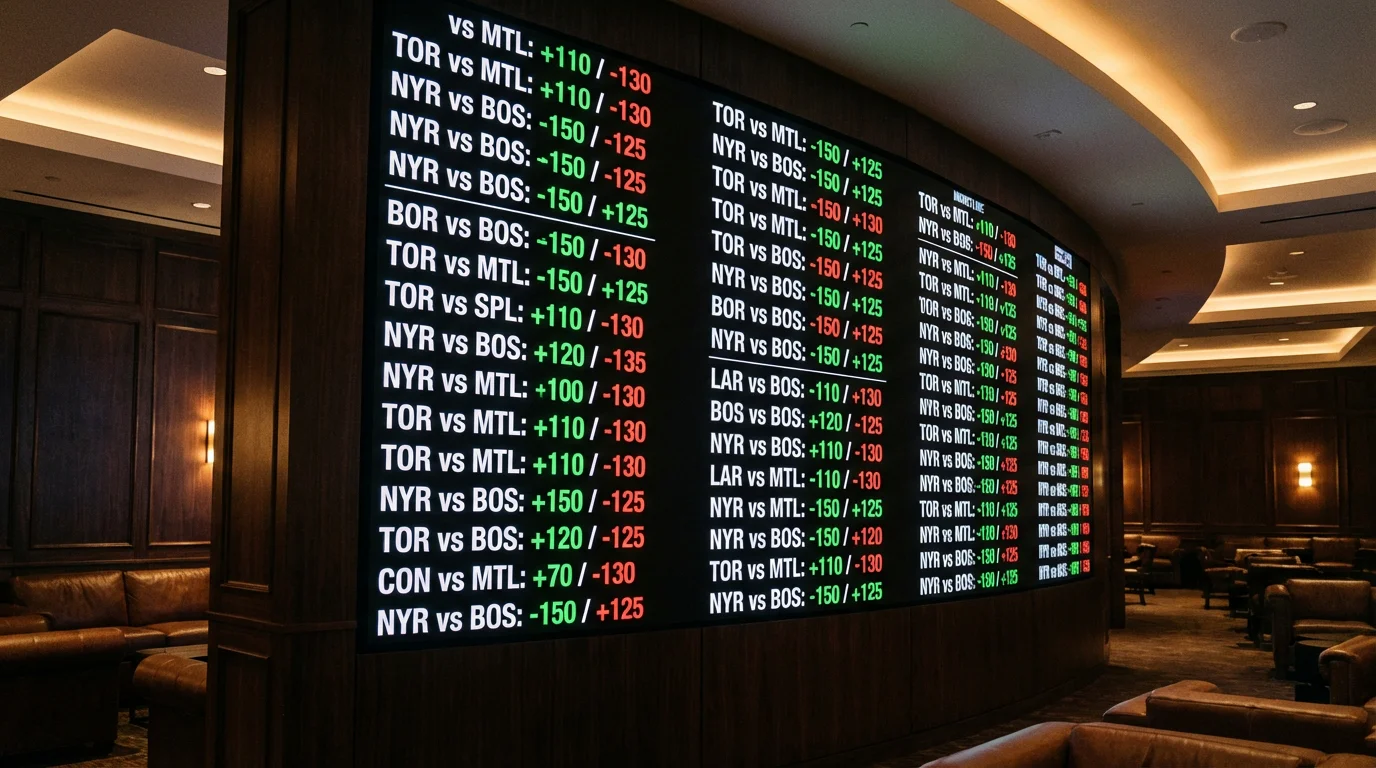
The odds you see when a line opens are not the odds you will see at puck drop. NHL betting lines are living organisms — they move, adjust, and recalibrate from the moment they are posted until the game begins. Understanding why lines move, who moves them, and what those movements signal is one of the most practical skills a hockey bettor can develop. It will not tell you who wins the game. It will tell you where the market sees value, and that is often more useful.
Line movement is not random. It follows patterns driven by identifiable forces: sharp betting action, public money, injury news, goaltender confirmations, and the book’s own liability management. Learning to read these movements transforms the betting line from a static price into a stream of information that updates in real time. The bettor who can interpret that stream accurately has a significant advantage over the one who checks the line once and bets without looking back.
Factors Driving NHL Betting Line Movement
NHL lines move for four primary reasons, and each carries a different signal.
Sharp action is the most influential driver. When professional or semi-professional bettors — sharps — place large wagers on one side of a game, the sportsbook adjusts the line in the direction of the bet. Sharp bettors are respected by the books because their track records demonstrate consistent profitability. When a sharp bettor puts significant money on an underdog, the book does not wait to see if the public agrees — it moves the line immediately to reduce its exposure to a bettor it considers well-informed.
Public money is the second driver. Recreational bettors tend to bet favorites, overs, and popular teams. When a high volume of small-to-medium wagers accumulates on one side, the book may adjust the line to balance its liability. Public-driven movement is typically slower and occurs closer to game time — the last two or three hours before puck drop — because casual bettors tend to place their wagers in the evening rather than the morning.
Information events are the third driver. In the NHL, the two most impactful information events are injury reports and goaltender confirmations. When a starting goaltender is announced — or a surprise backup is revealed — the moneyline, total, and puck line all adjust. When a key player is ruled out, the line moves to reflect the diminished team strength. These movements are reactive and often swift, creating brief windows where the line is in transition and the market has not fully settled on a new equilibrium.
The book’s own risk management is the fourth driver. Sportsbooks are businesses, and they manage their exposure across all games. If a book is heavily lopsided on one side of an NHL game — perhaps because a large sharp bet and heavy public action are both on the same team — it may move the line aggressively to attract action on the other side, even if its own model suggests the original line was accurate. This liability-driven movement can create value on the side the book is trying to attract bets to, because the adjusted line may overstate the probability of that outcome.
Reading Sharp Money Movements
Sharp action leaves fingerprints. Learning to identify those fingerprints is one of the most transferable skills in sports betting, and in the NHL, the patterns are particularly visible because the market is thinner than football or basketball.
The most reliable indicator of sharp money is reverse line movement — when the line moves in the opposite direction of where the majority of bets are being placed. If 70% of bets are on Team A, but the line moves toward Team B, it indicates that the 30% betting Team B includes sharp money that is moving more dollars than the 70% on Team A. The sharp minority is outweighing the public majority in terms of total handle, and the book is responding to the sharper side.
Timing is the second indicator. Sharp bettors tend to act early — within the first few hours after lines are posted — because that is when the market is most likely to be mispriced. If a line moves significantly between 10:00 AM and noon Eastern, before the general public has engaged, the movement is more likely sharp-driven than public-driven. Late-afternoon and evening movements are more ambiguous because both sharp and public money are active.
The speed and uniformity of a move provide the third signal. When a line moves quickly across multiple sportsbooks simultaneously — a steam move — it almost always originates with sharp action. A single sharp bettor placing a large wager at one book triggers an adjustment that is quickly replicated by other books to avoid being caught on the wrong side. Steam moves are the clearest signal of sharp opinion available to the retail bettor, and they happen frequently enough in NHL markets to be worth monitoring.
Goalie Confirmations and Injury News: The NHL’s Unique Line Movers
No other major sport has a single positional announcement that moves lines as reliably as the NHL’s starting goaltender confirmation. When a team confirms its number-one starter, the line holds steady or nudges slightly. When a team announces a backup — especially an unexpected one — the line can shift five to fifteen cents on the moneyline and half a goal on the total within minutes.
The timing of these announcements creates a predictable daily rhythm in NHL line movement. Most starting goalies are confirmed during morning skate, between 10:00 and 11:30 AM Eastern. The line adjustments that follow are rapid but not always complete. A book might move the moneyline from -140 to -125 after a backup is announced, but the true adjustment should be -115 based on the backup’s quality and the specific matchup. That incomplete adjustment is a window of opportunity — narrow, but real.
Injury news operates on a less predictable timeline. NHL teams are notoriously opaque about injuries during the regular season, often listing players as “day-to-day” without specifying the nature of the injury. When a key player — a top-line center, a number-one defenseman — is confirmed out, the line moves accordingly. But unlike goaltender announcements, which follow a daily schedule, injury news can break at any time, and the market’s response is not always proportionate.
The market tends to overreact to star offensive player injuries and underreact to defensive player injuries. A team losing its leading scorer generates headlines and public betting adjustments that can push the line too far, creating value on the injured team at its newly inflated underdog price. A team losing a top-pair defenseman who plays twenty-four minutes per night and anchors the penalty kill receives far less public attention, and the line may not move enough. These asymmetric reactions create a recurring pattern that informed bettors can exploit.
How to Interpret Line Shifts Before Placing a Bet
Reading line movement is not just about identifying which direction the line moved. It is about understanding the context behind the movement and deciding whether to follow it, fade it, or ignore it.
The first question is always: what caused the move? If the line shifted because of a goaltender announcement, the information is public and the adjustment is warranted. Following the move makes sense only if you believe the adjustment was insufficient — that the backup’s impact is larger than the line reflects. If the line shifted because of sharp action with no obvious news catalyst, the sharps may have identified a value angle that the book and the public have not yet recognized. Following a sharp-driven move early — before the line reaches its final resting point — can capture residual value.
The second question is: how far has the line moved? A small move — two or three cents on the moneyline — may be noise or a minor balancing adjustment. A large move — ten or fifteen cents — signals a significant shift in the market’s assessment. Large moves driven by sharp action deserve attention. Large moves driven purely by public money may deserve a contrarian look.
The third question is: where did the line open, and where is it now? The opening line is the book’s initial assessment. The closing line — the line at puck drop — is the market’s final consensus. Research consistently shows that the closing line is more accurate than the opening line, which means that the direction of movement from open to close generally indicates where the smarter money landed. Over the long term, bettors who consistently beat the closing line — placing bets at a better price than where the market closes — are profitable, and those who consistently get worse prices than the close are not.
This concept, known as closing line value, is the gold standard for evaluating betting performance independent of short-term results. If you are regularly beating the closing line, your process is sound even during inevitable losing streaks. If you are regularly getting worse prices than the close, your process needs work regardless of whether you happen to be on a winning run.
The Line Tells a Story — Learn to Listen
Every NHL betting line is a compressed narrative. The opening number tells you what the book’s model thinks. The early movement tells you what the sharps think. The late movement tells you what the public thinks. The closing number tells you what the aggregate market thinks. Each layer carries information, and the bettor who reads all four layers has a richer understanding of the game than the bettor who reads only the final price.
The practical application is straightforward. Check the line when it opens — usually the night before or early morning. Note the opening number. Check again after morning skate, when goaltender confirmations have been processed. Note any movement and its likely cause. Check one final time before deciding whether to bet, comparing the current line to your own projected price. If the line has moved toward your side, the market agrees with your thesis, but you are getting a worse price. If the line has moved away from your side, the market disagrees, but you are getting a better price — and your conviction in your own analysis needs to be strong enough to bet against the crowd.
That final decision — bet with the move or against it — is where line-reading skill meets analytical courage. Neither choice is always right. Both require judgment. And judgment, in betting as in everything else, is built through practice, tracking, and the honesty to admit when you read the story wrong.
